[II] Turn the Global Economic Crisis, war and a large-scale unemployment into world revolution!
(1)The Global Economic Crisis is rushing into a violent fall of Dollar and imperialism is plunging into an abyss
The Global Economic Crisis is an underlying factor of the world today, situation both at home and abroad as well as class relations and class struggle. Paris-bas shock in August 2007 sparked the worldwide financial crisis, which later developed into the present global economic crisis. The crisis is being intensified and the second or third bottom of the recession and even the “second Lehman shock” are seriously anticipated. The whole world economy is facing a danger of a violent fall of dollar and the collapse of the postwar world system of imperialism is imminent. Desperately optimistic views of the governments and bourgeoisie of the world that the world economy is “basically recovering” or “the recession has already reached its bottom”, etc. are actually betrayed by the real development.
The present global economic crisis is an outcome of the historical failure of neo-liberalism and globalism, conducted as a last resort of imperialism at its final stage. It is a crisis, surpassing in its serious character the Great Depression in 1929 and no exit from this is promised. The end of capitalism or imperialism is finally announced. The global economic crisis inevitably brings about a large-scale unemployment and war. The economic character and class nature of an economic crisis is clearly exposed by capitalist attempt to survive at the expense of working people on whom massive unemployment, wage-cut, deprivation of rights, poverty and destruction of life are imposed and whose life is driven to the bottom.
The deepening global crisis has produced mounting anger and intensifying struggle of working people all over the world against war and unemployment on the one hand, and fiscal catastrophe of the government and system crisis of the bourgeois state on the other hand. The world is plunging into a revolutionary situation. The future of working class of the whole world entirely depends upon the victory of the struggle, “to turn the global economic crisis into proletarian world revolution.
Fiscal mobilization and credit relaxation
Since “Lehman shock” on September 15 2008, with an aim of coping with the aggravating financial crisis, the governments of US and other major countries have developed an ultra relaxation policy on credit through fiscal pumping in astronomic amount and introduction of de-facto zero interest rate. At the same time, merciless restructuring, massive discharge and wage-cut have been imposed upon working people. These policies seemed to have temporarily mitigated a violent progress of the financial crisis.
As the statement of the president of the German Federal Bank, stressing, “Policy, policy and policy” in face of the economic crisis illustrates, the governments of Japan, US, Europe and also China took a large-scale fiscal measures: fiscal stimulus and fiscal stabilization fund of US amounts to respectively $787 bn. (\ 72tr.) and $700 bn. (\ 68tr.) and Chinese anti-cyclic measure cost 4trillion Gen (\54tr.), exceeding by far the expenditure during the period of the Great Depression. This time other various stopgap measures were also been taken to stimulate the economy: subsidy, tax-cut for the purchase of cars, electric appliances, houses as well as buying of government bonds, bonds, commercial papers, etc. But all these emergency measures have expired.
Astronomic budget deficits
A huge money pumping inevitably caused budget deficit. The US deficit of fiscal balance of the fiscal year 2009 rose to $1.4171tri. (\130tr.), 3.1 times larger than in the previous year. It is anticipated that the total deficit will reach $9 or 10bn in five years if $1bn.annual deficit continues from now on. The major European countries are also facing the same problem
Among other powers, Japan is hit the most violently by the deficit problem. The government bond outstanding amounts to \864tri.522.6bn, the largest ever sum in the history at the end of last September, while the government bond issue in 2009 fiscal year was \53.5tri. also the largest issuance ever. In March 2010, the government bond outstanding will be over \900tri.mark. This amount corresponds over 180% of GDP and in 2014, it will be larger than 246%. Japan faces now a bankruptcy as a state.
Until today, the US budget deficit has been covered by a large sum of purchase of China and Japan. It was possible within the limit of $400 bn, but impossible now that deficits amount to three or four times than that. As only way to meet this serious situation, FRB has to continue printing dollar paper without the guarantee of gold. When paper money is going to be issued limitlessly, what will come next? The answer is a violent fall of dollar and explosion of inflation.
“Collapse in the value of dollar” is a keyword of the current global economic crisis. It is unavoidable as a compound outcome of astronomical increase of US budget deficit, limitless issuance of US government bond, inevitable decline of US imperialism, ongoing intensification of international competition among imperialists and great powers and total failure of “international cooperation”. At any moment, dollar could violently collapse by any chance.
Let’s note the fact that today’s dollar has long lost its convertibility since August 15, 1971 when Nixon administration declared to stop conversion of dollar with gold and put and end to the international managed currency system of the postwar time. Therefore, dollar today is in fact no longer a key currency but only its substitute. The position and function of dollar as a pseudo key currency, or its substitute, has been barely maintained by the overwhelming economic, political and military power of US, while there has been no other currency to replace dollar. Now, however, the US is a declining super power that has triggered the global economic crisis. Worldwide sharp rise of gold price and weakening of dollar would inevitably lead to a collapse of the value of dollar.
When dollar finally collapses, the global economic crisis plunges into the abyss of catastrophe. Then the postwar imperialist world system will fall down into hell and the world economy will be broken up into closed blocks, intensifying competition among imperialist countries and great powers, a life-and-death battle for survival, and finally precipitating the whole world into a world war. No time is to be lost to rise up for a struggle “to turn the global economic crisis into world revolution”
Burst of bubble economy anticipated
There is another serious problem that is involved in the huge amount of government spending and the ultra policy of credit relaxation. Let’s see what is actually happening in the financial and money market. While we are witnessing, on the one hand, shrinking of credit, credit crunch and rising of the rate of interest of various credit cards and loans, the world economy is facing excessive money supply and a kind of bubble economy is emerging on the other hand. Excessive money, which is a product of US and other governments’ financial policy, is now flooding into stock market, future gold market and oil market in US, Europe and Asia and pulling the stock price, gold price and crude oil high. A fresh bubble economy is developing and is rushing for a burst once again.
Moreover, US financial institutions have bad assets of $1.5bn at most (according to US Congress Report) and house price is falling by 60~70%. Added to this, US financial world has a “fresh bomb”: uncollectable loan for real estate of commercial use (amounting to $3bn), which caused insolvencies of 133 US local banks by the middle of last December, followed by other 500 institutions in imminent danger. The global economic crisis will be fueled further by these developments of financial crisis in US.
(2)Massive unemployment is assaulting on workers as a result of the worldwide crisis
Bourgeoisie (Strausskahn, managing director of IMF) is warning that “the third wave of the economic crisis”, that is, massive unemployment will take place after the first wave, the financial crisis, and the second wave, sudden drop of real economy. The class background of the huge amount of governmental spending is drastic restructuring, wage-cut and massive unemployment at the sacrifice of workers.
According to the recent publication, the rate of unemployment in US has risen to 10.2%. This figure shows only a part of the reality: the figure will reach 20% when not only the people who are filed in employment insurance but also the workers whose employment insurance is expired or who gave up finding jobs or part-timers are taken into consideration. It is reported that the rate of overall unemployment in Japan last September was 5.3%, making a recovery in “successive two months”. But the figure is presented as “seasonably-adjusted” in quite a demagogic way. In reality, however, the rate of substantial unemployment will be greater when the figure includes those workers who are excluded form the figure on the ground that they worked even a day in a week, or who are paid “government subsidies for employment adjustment”(amounting to nearly two million). Then it will rise to 12.7% or 15.6%. In EU countries headed by Spain with its unemployment rate of 20%, the situation is quite similar to US and Japan.
Young workers are suffering under higher rate of unemployment. It is already close of 25%, a historically worst figure comparable only with the highest rate of overall unemployment in the period of the Great Depression in 1929.
Total failure of neo-liberalism
Now, the historical life of capitalism, or imperialism, is completely exhausted. It is clearly proved by the fact that the worldwide economic crisis in 1974~1975 smashed the postwar development of imperialism, sustained by the policy of state-monopoly capitalism since 1930’s and that the present global economic crisis has exposed ultimate failure of neo-liberalism and globalism which was taken a rescue policy thereafter.
The underlying cause of the worldwide economic crisis in 1974~1975 was excessive capital accumulation or excessive productive forces. After that it was impossible for real economy, or industrial corporation, to raise the rate of profit by any means. The neo-liberal policy that replaced the policy of state-monopoly capitalism dismantled welfare state policy and sought to increase capital profit, decreasing labor’s share through imposing wage-cut on, and intensifying exploitation of, working class. In pursuit of capital profit without restriction, policies of deregulation, privatization and union busting were vigorously practiced. It was materialized by Ronal Reagan, Margaret Thatcher and NAKASONE Yasuhiro, who, in Japan, enforced the Division and Privatization of National Railway.
Aggressive wage-cut has been imposed upon workers against the following background: since the collapse of Soviet Stalinism, eastern European countries as well as remaining Stalinist regimes like China have been integrated into the capitalist, or imperialist, world system and huge number of workers of these countries have become target of extraordinarily low wage and severe exploitation; while in capitalist or imperialist countries, exhaustive irregularization of employment has been carried out through destruction of the traditional systems, such as life-long employment and seniority wage system, etc, and lifting of the restriction on dispatching temporary workers in order to be allowed not only in the service area but also in industrial workplace.
Further, neo-liberal policy fiercely promoted financial liberalization in US and UK among others and brought about fantastic expansion of money game independent from the development of real economy and resulted in producing bubble economy and its repeated bursts. Thus capitalism has been transformed to be dependent on dangerous structure of precarious exploitation and oppression. The climax of these developments was the policy of the “Almighty Dollar” presented in 1995 by Edward Rubin, ex-Treasury Secretary of Clinton administration. It triggered a rapid expansion of IT (information technology) and housing bubble and its failure. In the course of these tumults, the division between banks and securities corporations was abolished in 1999 and the US has been transformed into a “Financial Empire” with extraordinary increase of “financial commodities”, in which the major players were investment banks, such as Goldman Sax and bankrupt Rehman Brothers.
(3)Protectionism, intensification of competition, block-building and war
The current global economic crisis forces a large-scale unemployment on working class on the one hand, and intensifies protectionism, competition among imperialists and other big powers on the other hand. Thus the crisis is driven further and brings about menace of collapse of dollar. The world economy contracts and splits. War of aggression and world war become imminent.
Prevailing protectionism is a very serious signal for world development. According to the figures published by WTO, 290 protectionist measures have been taken by 52 countries across the world since October 2008. Among those protectionist countries, India stands at the top of them with 42 cases and US with 35, followed by Argentina, China, Russia and so on. The most typical examples are: Buy-American clause and safeguard against tires made in China both by US. Other cases are: Higher customs, restriction on, or prohibition of, import, anti-damping measures, promoting policy of export of domestic products, reduction of taxes, subsidies etc. Currency war, or competition by devaluation of exchange rate, is another form of protectionism.
Protectionism inevitably produces chain reactions and turns into mutual retaliation as is actually happening between US and China. Though the official stance of “No protectionism” is adopted by the G20 Financial Summit Talks, that is now replacing G7 (Meetings of Financial Ministers and presidents of Central Banks of seven major countries), the general world trend is a rush for protectionism.
Obama’s Tokyo Speech
The global economic crisis is sharply intensifying competition between imperialist and other big powers in political, diplomatic and military fields over the market, resources and the sphere of influence. We are witnessing before our eyes a death battle between Japan and USA, which poses a serious problem.
On November 14, 2009, during his East Asian tour, US president Obama made a speech in Tokyo (“Tokyo Speech”), on the general picture of his Asian policy. He stated that US is a “Nation on the Pacific Ocean ” and declared US’s “positive commitment in, and contribution to, Asia”. Obama told that US will officially attend “East Asian Summit Talks” and that he will seek cooperation with ASEAN (Association of Southeaster Asian Nations) for the first time, not only with APEC (Asian-Pacific Economic Cooperation Conference). Further it was stated that US will take responsibility for the security of Japan and Asia countries and expects “Asian Allies, including Korea and Japan”, to “maintain effective deterring forces against nuclear attacks” in a quite overt way.
Obama’s speech is, first of all, made against the background of Japan-US Alliance, an open declaration of confrontation and competition with China, which has been emerged as a new big nation surpassing Japan and Germany in its gigantic economic scale. China, remaining Stalinist country, is for US to be drawn into cooperation on the one hand and to be contained on the other hand. At the same time, we must not overlook that Obama declared a fierce confrontation against Japanese imperialist regime, Hatoyama administration, that emerged with slogans: “close and equal Japanese Alliance (or Partnership) with US” “construction of East Asian Community” to compete with US over the hegemony. Obama made it clear by his “Tokyo Speech” that US will hold tight its hegemony over Asia economically as well as militarily and never allow Japanese imperialist scheme of building an East Asian Community that excludes US.
New Stage of Japan-US Competition
As is illustrated above, since the Administration of Democratic-Rengo Alliance under Ozawa-Hatoya leadership took power, Japan-US competition has been intensified in the sharpest way ever. The issue of the transfer of Hutenma US base in Okinawa is one of the acute problems that are shaking Japan-US Security Alliance as the struggle of Okinawa people against US bases fiercely develops. Another burning issue between Japan and US is the competition over the air transport, exposed by the conflict on the conclusion of the “Open Sky Agreement” (Liberalization of the air transport). These two issues, Okinawa and air transport, will inevitably become focus of the struggle in 2010: Okinawa struggle and Sanrizuka struggle against Narita Airport.
US economy, that had produced “boom” through excessive consumption at the background of housing bubble and rapid increase of deficit in current account, collapsed by the break-out of the global economic crisis. In face of this adverse situation, US government took an initiative of making G20 as main stage and organ of world economic conference in close cooperation with one of the emerging powers, China, at G20 Financial Summit meeting at the end of September 2009, in Pittsburg in US. At the meeting, countries with current account surplus, such as Japan, Germany and China were requested to “adjust imbalanced current account” and to “increase domestic demands”. The intention of US imperialism is to compete with Japan and European countries through inviting China on the side of US as was demonstrated by the promotion of G2 (US-China strategic and economic dialogue) and the proposal of holding G4 (US, China, Japan, EU) conference.
A dangerous development is going on before us: war of aggression and world war are becoming more and more imminent as protectionist policy prevails world-wide under the global economic crisis and competition intensifies among imperialist and other big powers. Obama, while preaching a “world without nuke” to pro-establishment forces in a deceitful way, demands Japan and South Korea steady maintenance of deterrent forces against nuke and insists on strengthening of “nuclear nonproliferation regime”. Thus he demonstrates the will of US imperialism to wage war of aggression and world war in order to maintain US global domination.
US dispatches more troops to Afghanistan
On December 1, 2009, Obama decided to send more 30,000 troops, including 9000 Marines to Afghanistan, a strategic stronghold of imperialist war of aggression. NATO followed US in dispatching 7,000 more troops there. Thus Afghanistan has become a cutting edge of war of aggression and world war participated by US, European and Japanese imperialists with 100.000 US forces and 140,000 foreign troops permanently staying there. For US, Afghanistan has completely become the “second Vietnam”.
United power of the whole world and their uprising can turn the global economic crisis and war into world revolution.
(4)Down with the administration of Democratic Party and Rengo of Constitutional Revision, War and Massive Unemployment
As the global economic crisis aggravates, the postwar world system of imperialism has begun to collapse fundamentally. Japanese imperialism, the weakest link of the chain of international imperialism, is being hit most terribly by the world crisis and its ruling system is plunging into catastrophe. “August 30th”, the day of general election in 2009, in which the ruling Liberal Democratic Party suffered a decisive defeat and lost its political domination for a half century, symbolizes it.
The new administration is under the leadership of Hatoyama, the Prime Minister and Ozawa, the general secretary of Democratic Party and this Democratic Party administration is sustained by labor bosses of Rengo (Japan Trade Union Confederation). Its role is only to intensify the crisis and contradictions of Japanese imperialism. We must clarify the historical character and position of Hatoyama administration. Its cruel and reactionary nature as well as its critical and fragile essence should be exposed thoroughly. Let’s overthrow Democratic-Rengo administration with this accurate perception, and march for proletarian revolution!
The most serious system crisis after World War II
Firstly, the Hatoyama administration is born against the background of the collapsing Japanese imperialism. The current global crisis has driven Japanese economy into catastrophe. The structure of capital accumulation of Japanese economy based on the practice of “export nation” has fallen down and Japanese economy has been thrown into deflationary spiral again. Mounting budget deficit is driving fiscal crisis beyond the limit. While the tax income in 2009 fiscal year amounts only to \36.9 trillion, the state finance needs issuance of government bond of \53.5 trillion. It is the worst situation since the chaotic period immediately after the defeat in World War II.
The Ampo (Japan-US Security Alliance) issue and diplomatic policy face also a deadlock. A period of instability and catastrophe has begun. The Japan-US Alliance will not go on smoothly as before from the interest of both sides. It is most drastically demonstrated by the conflict between the two countries on the issue of Hutema US base as mentioned above. Angry voices of Japanese working people headed by people in Okinawa is violently mounting and developing into an explosion of anti-war, anti-nuke, anti-Ampo and anti-base struggle, shaking both of Japanese and US governments. On the other hand, imperialist competition is intensifying between Japan and US under the worldwide economic crisis far beyond the previous friction. The basic policy of US imperialism, axial state of the world in historical decline, is “to engage actively in Asia” and to prevent by all means Japanese independent mlitarization and crush its attempt of making Asia Japan’s own sphere of influence.
A far more brutal administration than the Liberal-Democratic rule
Secondly, the Hatoyama administration intends, in face of antagonistic US policy toward Japan, to confront and overcome the crisis of Japanese imperialism through carrying out the independent policy of its own, namely, Ampo and defense policy, Asian policy and policy of revising the constitution and militarization of Japanese state, or construction of a war-like nation. These policies are formulated as, “close as well as equal Japan-US Union (or partnership)” “construction of East Asian community” “reviewing of Japan-US agreements” etc. which openly expose its will of competing with US and demanding Japanese independent stand from US. The administration of Democratic Party and Rengo is intent to carry out a reactionary conversion of the state machinery and the revision of the constitution to wage war, a political goal unachieved by the Liberal-democratic administrations, destroying the existing structure established as parts of the “1955 System” (post-postwar system) and long maintained under the Liberal-Democratic domination. The practice of this policy again intensifies Japan-US conflict and competition further.
In regard to the domestic problems, the DP-Rengo administration insists on “independence from bureaucracy” “cut down on waste” and force “reorganization and re-arranging of the budge distribution” through a demagogic and quasi-Fascist method. A fierce attack is concentrated on public service workers through dismissing 3.6 million workers through introduction of the Wider Regional Administrative System. These policies are all conducted by the help of corrupt labor leaders of Rengo.
Decisive fragility of Hatoyama administration
Thirdly, it is to be noted that the brutal character of Hatoyama administration surpassing the LDP’s politics is closely combined with its desperately fragile and critical nature.
This administration is a product of the global economic crisis and the collapse of imperialist world system that caused the failure of the LDP domination. The critical point now is that there is no possibility of the historical recovery of LDP even if DP-Rengo rule should fail. The “1955 System” definitively collapsed and the world is plunging into a new age of the greatest turbulence and upsurge. The present crisis of ruling system of imperialism is so far-reaching and fundamental. The Hatoyama administration is, different from its predecessor, LDP, sustained by the Rengo, a corrupt leadership of national labor center as its necessary pillar. This is a marvelous opportunity for proletarian revolution. The historical moment of victory has come. Overthrowing the corrupt leadership of Rengo and smashing the DP-Rengo administration, we can proceed the way for the victory of proletarian revolution.
Under the intensifying imperialist competition, Japan-US alliance is on the brink of disruption, as Hatoyama administration desperately forces its policy of constitutional revision and militarization regardless, or in defiance of, US concern on Japanese violent and independent drive. Hatoyama and Ozawa have an intention of establishing a dictatorial and repressive regime through instigating patriotism and nationalism and mobilizing even rightwing, including Fascist forces with anti-US tendency. It is also evident that Japanese ruling class as a whole is in the midst of total confusion and is searching for a new orientation and reorganization. It offers us, class struggle labor movement and revolutionary forces, a golden opportunity to resolutely rise up and seize power.
The scheme of introducing Doshu-sei (Wider Regional Administrative System) is a materialization of the reactionary and counterrevolutionary policies conducted by DP-Rengo administration together with Keidanren (Japan Federation of Economic Organizations): “sweeping and drastic reform” “to change the society and the world” “an attempt of transforming the basic structure of the state” etc. It is by no means possible, however, to carry out these plans without destroying the struggle of major four industries with national railway workers at the forefront and class struggle labor movement. Moreover, the scheme of Doshu-sei is full of contradictions. It pretends to promote “regional sovereign states” by local bourgeois autocracy, but in fact the essential authority is concentrated in the central government, such as decision on military and diplomatic issues. There is also problem about the budget, for example of military expenditure, etc.
The major concern of Hatoyama and Ozawa is now directed at gaining a victory with working majority in the coming election of the Upper House in July and establish a dictatorial administration to launch overall counterrevolutionary offensives. The development of class struggle, however, will surely frustrate their plan. Angry workers have already begun rising up, disillusioned by the new administration, as is illustrated by the rapid drop of popular rating of the DP-Rengo government. At the forefront of the fighting rank to change the whole political situation, working class of Okinawa is leading the struggle with the demand, “Shut down Hutennma US base immediately!” “Stop construction of a new base in Henoko!”
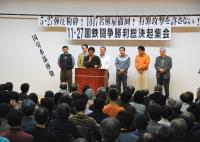
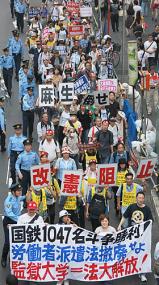
Let’s rise up and win the struggle of national railway workers to withdraw the dismissal of 1047 railway workers, to stop overall outsourcing of inspection and repair works and to overthrow JR (Japan Railway Companies) system!
Let’s fight to crush DP-Rengo administration prior to the Upper House election!
Let’s organize a general mobilization for the decisive battle in 2010 to achieve the victory of proletarian revolution.
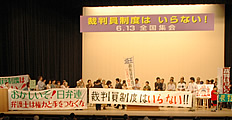 裁判員制度はいらない 11月全国一斉行動 さぁ廃止だ 東京集会・銀座デモ